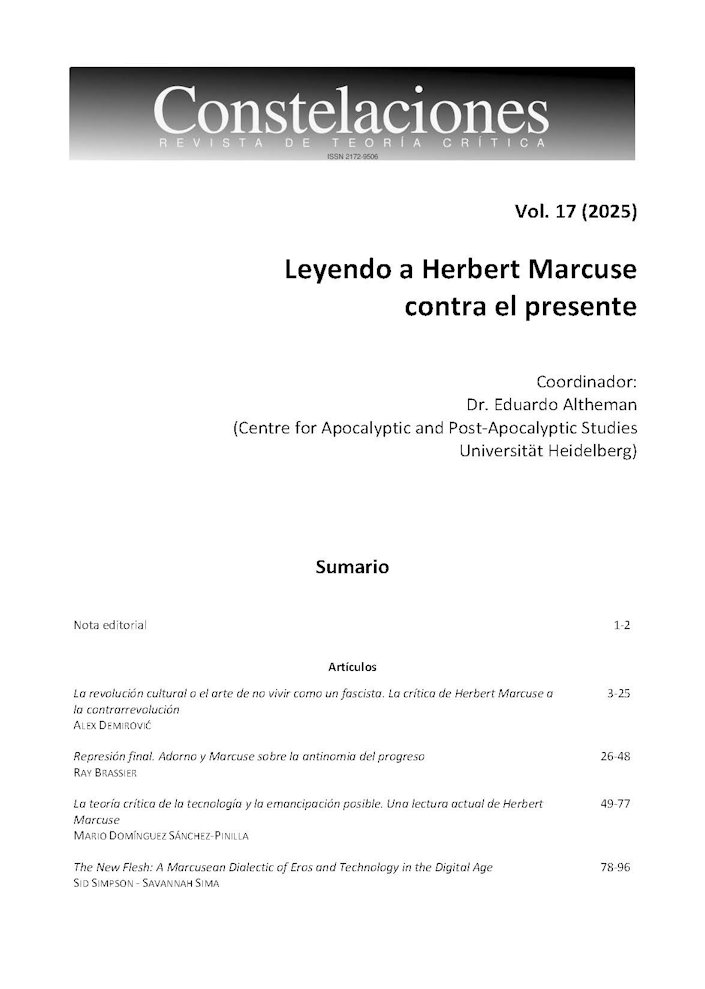
Final Repression. Adorno and Marcuse on the Antinomy of Progress
Keywords:
progress, freedom, repression, jouissance, Theodor W. Adorno, Herbert MarcuseAbstract
The essay reconstructs the antinomy between progress and repression in Adorno and Marcuse through Freud. Against linear historicism, it follows Benjamin’s messianic discontinuity and, with Adorno, reframes progress as resistance to the compulsion of domination and to the idolatry of history. Countering Marcuse’s promise of a historical culmination in which repressive progress is sublimated into freedom and play, the text questions the split between “basic” and “surplus” repression and the substantialization of libido. In dialogue with Lacan and Zupancic, it proposes understanding repression as an originary process that constitutes jouissance and twists historical time. Emancipation is thus relocated in identifying the specific knots where enjoyment and repression mutually sustain each other.
Downloads
References
ADORNO, Theodor W. (1973): Negative Dialectics, trad. de E. B. Ashton, Londres y Nueva York: Routledge.
ADORNO, Theodor W. (2005a): “Progress”, en Critical Models: Interventions and Catchwords, trad. de Henry Pickford, Nueva York: Columbia University Press, 143-160
ADORNO, Theodor W. (2005b): “Marginalia to Theory and Praxis”, en Critical Models: Interventions and Catchwords, trad. de Henry Pickford, Nueva York: Columbia University Press, 259-278.
BENJAMIN, Walter (2003): “On the Concept of History”, en Selected Writings, Vol.4: 1938-1940, trad. de E. Jephcott, Cambridge, Massachusetts y Londres: The Belknap Press of Harvard Universtiy Press, 389-400.
DELEUZE, Gilles/ GUATTARI, Felix (1983): Anti-Oedipus: Capitalism and Schizophrenia, trad. de R. Hurley, M. Seem y H.R. Lane, Minneapolis: University of Minnesota.
FREUD, Sigmund (2002): Civilization and its Discontents, trad. de D. McLintock, Londres y Nueva York: Penguin.
HAUG, Wolfgang F. (2017): “On the Need for a New English Translation of Marx´s Capital”, en Socialism and Democracy¸ 31(1), 2017, 60-86.
MARCUSE, Herbert (1955): Eros and Civilization: A Philosophical Investigation into Freud, Boston: Beacon Press
MARCUSE, Herbert (1970a): “Progress and Freud´s Theory of Instincts”, en Five Lectures. Psychoanalysis, Politics, and Utopia, trad. de J. J. Saphiro y S. M. Weber, Londres: Allen Lane The Penguin Press, 28-43.
MARCUSE, Herbert (1970b): “The End of Utopia”, en Five Lectures. Psychoanalysis, Politics, and Utopia, trad. de J. J. Saphiro y S. M. Weber, Londres: Allen Lane The Penguin Press, 62-86.
ZUPANCIC, Alenka (2008): Why Psychoanalysis. Three Interventions, Aarhus: Aarhus Universitetsforlag.
ZUPANCIC, Alenka (2017): “Hegel and Freud: Between Aufhebung and Verneinung”, en Crisis and Critique, vol. 4 (1), 2017, 481-494.
Downloads
Published
How to Cite
Issue
Section
License
Copyright (c) 2025 Ray Brassier

This work is licensed under a Creative Commons Attribution-NonCommercial-ShareAlike 4.0 International License.
Authors who have publications with this journal accept the following terms:
1. Authors will retain their copyright and grant the journal the right of first publication of their work, which will be simultaneously subject to the License of recognition of Creative Commons CC BY-NC-SA 4.0 that allows third parties to share, redistribute and adapt the work provided it is for non-commercial purposes and its author and first publication in this journal is indicated.
2. Authors may adopt other non-exclusive distribution license agreements for the version of the published work (e.g., depositing it in an institutional electronic archive or publishing it in a monographic volume) provided that the initial publication in this journal is indicated.
3. Authors are permitted and encouraged to disseminate their work via the Internet (e.g., in institutional telematic archives or on their website) before and during the submission process, which can produce interesting exchanges and increase citations of the published work. (See The Effect of Open Access).
Data confidentiality
1. Constelaciones. Revista de Teoría Crítica guarantees that the data you send us will only be used to meet the requests made in this message.
2. Your data will not be passed on to third parties.
3. You may request that your data be removed from our records at any time.