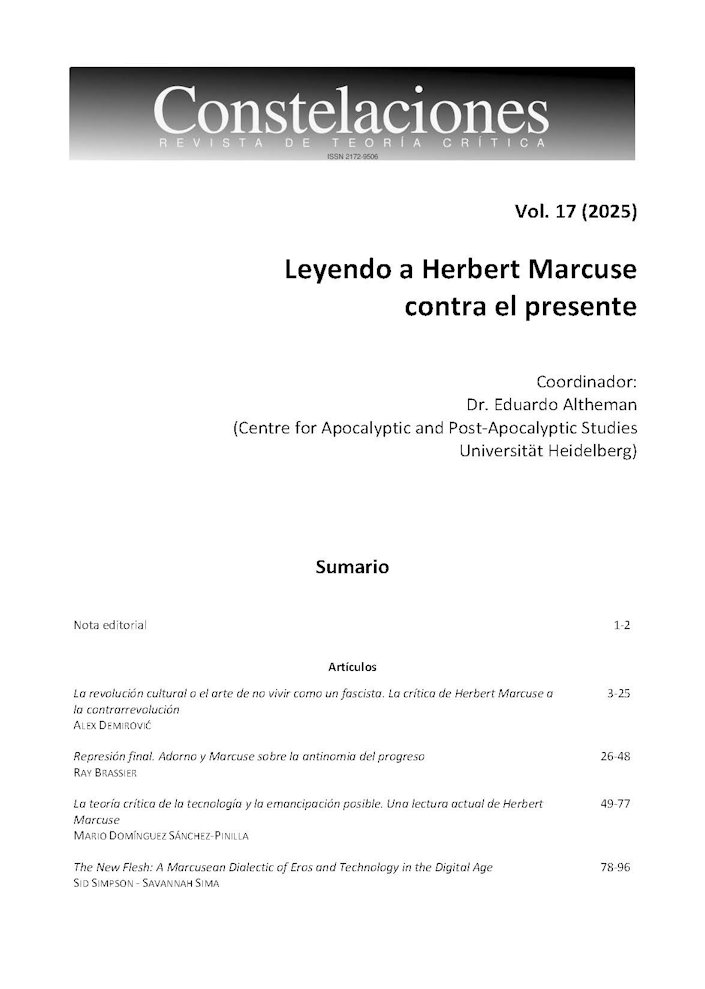
The New Flesh. A Marcusean Dialectic of Eros and Technology in the Digital Age
Keywords:
Marcuse, Eros, Technology, Technics, InternetAbstract
In this article, we offer a critical theory of the internet grounded in Marcuse’s dialectical theory of technology, starting from what we contend to be the fundamental and indispensable core of his thinking: the dialectic between eros and technological rationality. We proceed below in three parts: First, we critically reconstruct Marcuse’s dialectic of eros and technological rationality to set the stage for our discussion of the internet. Second, we use Marcuse’s distinction between technology and technics to interrogate the internet as a material reflection of the social process out of which it emerged. Under conditions of advanced industrial civilization, it is not surprising that the internet appears as a material reflection of technological rationality. In the final section, we seek to answer the questions raised by the preceding sections: If the internet frustrates our need for erotic connection, rendering desire one-dimensional, would an erotic technology of liberation include the internet? If so, would that internet look anything like what it does now?
Downloads
References
ADORNO, Theodor (1991): “Resignation.” In Theodor Adorno: The Culture Industry. New York: Routledge, 198-203.
BARLOW, John Perry (1996): “A Declaration of the Independence of Cyberspace.” Electronic Frontier Foundation. Accessed 15/7/2025: https://www.wired.com/1997/09/newrules/
CRARY, Jonathan (2022): Scorched earth: Beyond the digital age to a post-capitalist world. New York: Verso books.
CRONENBERG, David. (Director): (1983): Videodrome. Universal City: Universal Pictures.
CROWE, C. L., LIU, L., BAGNAROL, N., & FRIED, L. P. (2024): Loneliness prevention and the role of the public health system. Perspectives in public health, 144 (1), 31-38.
DEAN, Jodi (2003): Why the Net is not a Public Sphere. Constellations: An International Journal Of Critical & Democratic Theory, Vol. 10(1), 95-112.
DELLA TORRE, Bruna (2024): “21st Century One-Dimensionality: Bit Technologi¬cal Rationality, Digital Culture Industry, and Platform Postmodernity.” In Eduardo Altheman C. Santos, Jina Fast, Nicole K. Mayberry, and Sid Simpson (eds): The Marcusean Mind. New York: Routledge, 510-521.
DUFFY, Clare (2024): “‘There are no guardrails.’ This mom believes an AI chatbot is responsible for her son’s suicide.” CNN. Accessed 15/7/2025: https://www.cnn.com/2024/10/30/tech/teen-suicide-character-ai-lawsuit
FEENBERG, Andrew (2008): “Critical theory of technology: An overview.” In Gloria J. Leckie and John E. Buschman, (eds.): Information technology in librarianship: New critical approaches. Bloomsbury Publishing, 31-46.
FEENBERG, Andrew (2017): Technosystem: The social life of reason. Cambridge: Harvard University Press.
FUCHS, Christian (2016): Critical theory of communication: New readings of Lukács, Adorno, Marcuse, Honneth and Habermas in the age of the internet. University of Westminster Press.
GARLICK, Steve (2011): “Complexity, Masculinity, and Critical Theory: Revisiting Marcuse on Technology, Eros, and Nature.” Critical Sociology. Vol 39(2), 223-238.
HORKHEIMER, Max, ADORNO, Theodor W. (2002): Dialectic of enlightenment. Noeri, Gunzelin (trans). Redwood City: Stanford University Press.
KELLY, Kevin (1997): “New Rules for the New Economy.” Wired. Accessed 7/15/2025: https://www.wired.com/1997/09/newrules/
MARCUSE, Herbert ([1941] 1998): "Some social implications of modern technology." In Herbert Marcuse: Technology, War, and Fascism. New York: Routledge, p. 39-65.
MARCUSE, Herbert (1964): One-Dimensional Man: Studies in the Ideology of Advanced Industrial Society. Boston: Beacon Press.
MARCUSE, Herbert (1965): "Industrialization and Capitalism in the Work of Max Weber.” In Negations: Essays in Critical Theory. London: Allen Lane, 201-226.
MARCUSE, Herbert (1966): Eros and Civilization. Boston: Beacon Press.
MARCUSE, Herbert (1969): An Essay on Liberation. Boston: Beacon Press.
MARCUSE, Herbert ([1979] 2011): "Children of Prometheus: 25 Theses on Technology and Society." In Herbert Marcuse: Philosophy, Psychoanalysis, and Emancipation. New York: Routledge, 222-225.
NEGROPONTE, Nicholas (1995): Being Digital. New York: Knopf.
SIMPSON, Sid (2024): “Dialectics of Domination and Eros: Herbert Marcuse and the Critique of Technological Rationality.” In Eduardo Altheman C. Santos, Jina Fast, Nicole K. Mayberry, and Sid Simpson (eds): The Marcusean Mind. New York: Routledge, 137-149.
UNITED NATIONS INSTITUTE FOR TRAINING AND RESEARCH (UNITAR) (2024): “Global E-Waste Monitor 2024: Electronic Waste Rising Five Times Faster than Documented E-Waste Recycling. Accessed 15/7/2025: https://unitar.org/about/news-stories/press/global-e-waste-monitor-2024-electronic-waste-rising-five-times-faster-documented-e-waste-recycling
WEISSBOURD, Richard, Milena BATANOVA, Virginia LOVISON, and Eric TORRES (2021): “Loneliness in America: How the Pandemic Has Deepened an Epidemic of Loneliness and What We Can Do About It.” Making Caring Common Project. Accessed 15/7/2025: https://static1.squarespace.com/static/5b7c56e255b02c683659fe43/t/6021776bdd04957c4557c212/1612805995893/Loneliness+in+America+2021_02_08_FINAL.pdf
Downloads
Published
How to Cite
Issue
Section
License
Copyright (c) 2025 Sid Simpson, Savannah Sima

This work is licensed under a Creative Commons Attribution-NonCommercial-ShareAlike 4.0 International License.
Authors who have publications with this journal accept the following terms:
1. Authors will retain their copyright and grant the journal the right of first publication of their work, which will be simultaneously subject to the License of recognition of Creative Commons CC BY-NC-SA 4.0 that allows third parties to share, redistribute and adapt the work provided it is for non-commercial purposes and its author and first publication in this journal is indicated.
2. Authors may adopt other non-exclusive distribution license agreements for the version of the published work (e.g., depositing it in an institutional electronic archive or publishing it in a monographic volume) provided that the initial publication in this journal is indicated.
3. Authors are permitted and encouraged to disseminate their work via the Internet (e.g., in institutional telematic archives or on their website) before and during the submission process, which can produce interesting exchanges and increase citations of the published work. (See The Effect of Open Access).
Data confidentiality
1. Constelaciones. Revista de Teoría Crítica guarantees that the data you send us will only be used to meet the requests made in this message.
2. Your data will not be passed on to third parties.
3. You may request that your data be removed from our records at any time.