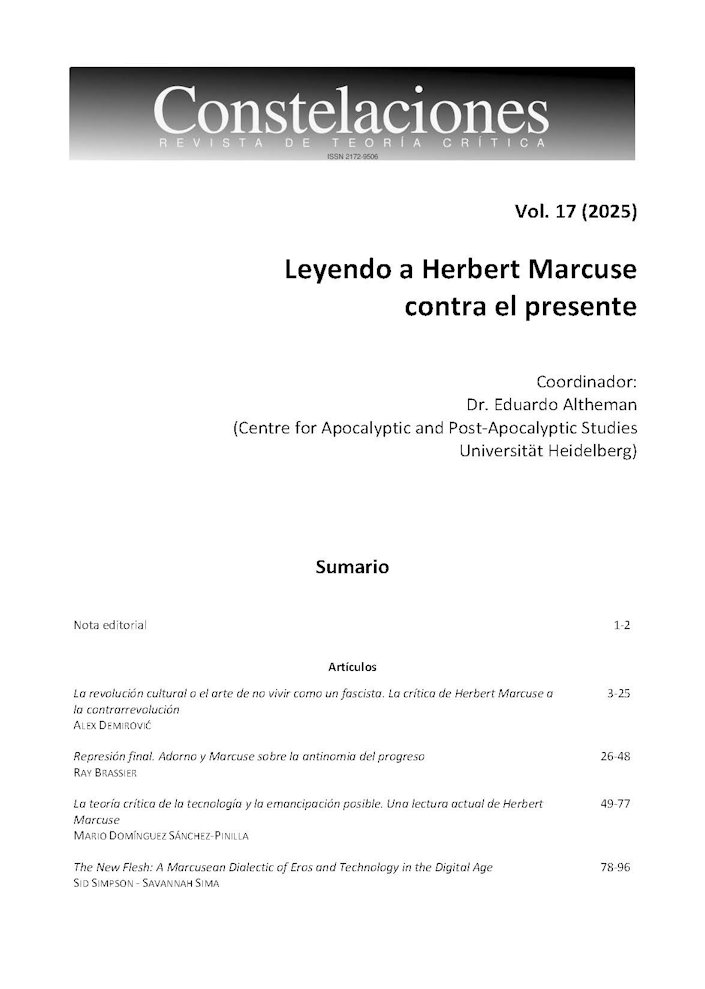
The Cultural Revolution or the Art of Not Living Like a Fascist. Herbert Marcuse's Critique of the Counterrevolution
Keywords:
Herbert Marcuse, cultural revolution, New Left, Fascism, Counterrevolution, An Essay on LiberationAbstract
An epoch has come to an end. It marks a rupture in historical development, a change of epoch. Names such as Herbert Marcuse represent what must be attacked and destroyed, what must be eliminated from the world. At the beginning of this new epoch, in the years after 1967/68, there was an awakening in many sectors of capitalist societies. It was a peculiar combination of struggles against a certain bourgeois principle of reality: imagination was to come to power. Herbert Marcuse contributed important texts to the debates of the time and reflected on this phase of an emerging Left and a non-fascist, anti-conformist way of life, while observing a tendency towards preventive counterrevolution in democratic societies. As a Jewish Marxist and émigré, as someone who, with his expertise as a social theorist, had studied and fought fascism and had taken part in the civil rights movement, the revolt, and the New Left, he warned of the threat of a new, second fascism. His later writings sketch this threat and include proposals for a non-fascist way of life.
Downloads
References
ADORNO, Theodor W. (1966): Dialéctica negativa, en Obra completa, vol. 6, Tres Cantos-Madrid: Akal, 2005.
BALIBAR, Etienne (1990): “Gibt es einen ‘Neorassismus’?” en Etienne Balibar, Immanuel Wallerstein: Rasse – Klasse – Nation. Ambivalente Identitäten, Hamburg: Argument.
BLASIUS, Dirk (2005): Weimars Ende. Bürgerkrieg und Politik 1930-1933, Göttingen: Vandenhoeck & Ruprecht.
BRAND, Ulrich, WISSEN, Markus (2017): Imperiale Lebensweise. Zur Ausbeutung von Mensch und Natur im globalen Kapitalismus, München: oekom.
DEMIROVI?, Alex (2025): “Do We Need an Updated Theory of Fascism”, https://www.rosalux.de/en/news/id/53445/do-we-need-an-updated-theory-of-fascism.
ENGELS, Friedrich (1851-1852): Revolution und Konterrevolution in Deutschland, en Marx-Engels-Werke, vol. 8, Berlin: Dietz, 1972.
FOUCAULT, Michel (1999): “Prefacio”, en Id.: Obras esenciales, II: Estrategias de poder. Barcelona: Paidós, 385-388.
FRASER, Nancy (1994): Widerspenstige Praktiken, Frankfurt am Main: Suhrkamp.
HARCOURT, Bernard E. (2019): Gegenrevolution. Der Kampf der Regierungen Gegen die eigenen Bürger, Frankfurt am Main: Fischer.
HARCOURT, Bernard E. (2025): A Modern Counterrevolution, The Ideas Letter 39,
https://www.theideasletter.org/essay/a-modern-counterrevolution/ [11.10.2025]
JESSEN, Jens (2025): “Selbst schuld?“, Die Zeit, 28.8.2025.
KRACAUER, Siegfried (1938): Totalitäre Propaganda, en id.: Werke, vol. 2.2: Studien zu Massenmedien und Propaganda, Berlin: Suhrkamp, 2012.
MARCUSE, Herbert (1964): EL hombre unidimensional. Ensayo sobre la ideología de la sociedad industrial avanzada. Barcelona: Ariel, 1984.
MARCUSE, Herbert (1969): Ensayo sobre la liberación. México: Editorial Joaquín Mortiz.
MARCUSE, Herbert (1970): Revolución cultural. Medellín: ennegativo ediciones, 2021.
MARCUSE, Herbert (1972): Contrarrevolución y revuelta. México: Editorial Joaquín Mortiz, 1973.
MARCUSE, Herbert (1975): “Scheitern der Neuen Linken?”, en id.: Schriften vol. 9, Frankfurt am Main: Suhrkamp, 1987.
MAYER, Arno (1971): Dynamics of Counterrevolution in Europe, 1870-1956, New York et all: Harper & Row.
WHITE HOUSE (2025): Defending women from gender ideology extremism and restoring biological truth to the federal government, Washington.
Downloads
Published
How to Cite
Issue
Section
License
Copyright (c) 2025 Alex Demirovic

This work is licensed under a Creative Commons Attribution-NonCommercial-ShareAlike 4.0 International License.
Authors who have publications with this journal accept the following terms:
1. Authors will retain their copyright and grant the journal the right of first publication of their work, which will be simultaneously subject to the License of recognition of Creative Commons CC BY-NC-SA 4.0 that allows third parties to share, redistribute and adapt the work provided it is for non-commercial purposes and its author and first publication in this journal is indicated.
2. Authors may adopt other non-exclusive distribution license agreements for the version of the published work (e.g., depositing it in an institutional electronic archive or publishing it in a monographic volume) provided that the initial publication in this journal is indicated.
3. Authors are permitted and encouraged to disseminate their work via the Internet (e.g., in institutional telematic archives or on their website) before and during the submission process, which can produce interesting exchanges and increase citations of the published work. (See The Effect of Open Access).
Data confidentiality
1. Constelaciones. Revista de Teoría Crítica guarantees that the data you send us will only be used to meet the requests made in this message.
2. Your data will not be passed on to third parties.
3. You may request that your data be removed from our records at any time.